Lara Avery’s “Anything but the Ordinary”: Life in a Different Perspective
Reviewed by Emma Davitz
Every second of life matters: every breath, every smile, every tear. Losing time is everyone’s biggest fear; we are afraid of dying without fulfilling life’s greatest experiences. Every night we go to bed for 8-10 hours. Imagine going to bed for five years and suddenly waking up unaware of your surroundings. This is what happens to 17-year-old ordinary teenager, Bryce, in the heartwarming and shocking story of Anything But the Ordinary.


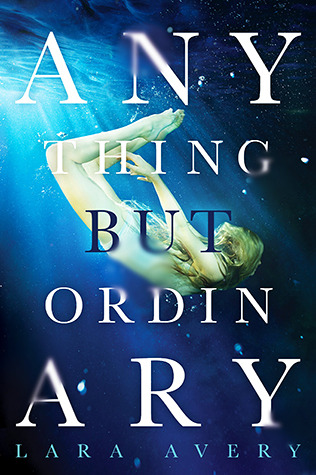 Diving was the only thing that made Bryce feel like she was alive. It was Bryce’s passion, but more like her life. Diving was also the reason she ended up in a five year coma with a serious head injury. Lara Avery’s Anything But the Ordinary creates laughter, tears, and makes people look at the world in a different perspective. The story mainly follows the recovery of Bryce after her accident, but also goes into deep description of the hallucinations and memories of Bryce’s “interesting” mind. “...each step bringing back memories of the life she had left behind” (Avery 52). Bryce’s physical recovery is just as difficult as her emotional recovery. She wakes up learning that her innocent 12-year-old sister is now a 17-year-old delinquent, her loving parents rarely speak, and her boyfriend, Greg, is now marrying her best friend, Gabby. Bryce feels as if her life is broken until she meets a hospital intern, Carter, who not only helps her with her recovery, but teaches her the true meaning of life and happiness.
I found this book to be very touching and meaningful. Some books with similar themes tend to be very predictable or cheesy. This was not the case in Anything but the Ordinary. Avery has you second guessing every decision and has you relating the themes to your own life. A general theme of this book has to do with freedom. Bryce seizes freedom because she was trapped for five years. Her doctor once states, “No patient has ever been so feisty about her freedom. It made me look at all my patients differently” (Avery 276). Bryce would rather suffer pain in the outside world and live through life’s greatest experiences, than live in a hospital bed with constant care. Bryce’s stubborn personality is the reason for her “feisty” actions. This story reminds you to never give up, seek freedom, and treat every moment as if it were your last.
Anything but the Ordinary also contains well-developed characters with unique personalities. Bryce’s personality and character are shaped by her actions and reactions throughout the story. She is truly a thoughtful, determined, and sympathetic woman. She fights against the odds with every challenge given to her. She had to learn to walk again, to communicate with her friends again, and to deal with every obstacle of living in her way. Her sister, Sydney is well defined also. Sydney is described as a teenage girl who does drugs and goes to parties. Throughout the story, Avery describes Sydney’s reason for her actions. Sydney is actually a very hardworking girl who turns to drugs and alcohol when she is upset. The descriptions of Sydney made me think of first impressions and judging. My first impression of Sydney was that she was a party girl who did not have any ambitions or goals in life. In the middle of the story the author makes me realize how I cannot judge someone by his or her appearance. Sydney is really a hardworking girl who has lived a tough life with her sister’s accident and her parents fighting.

One flaw in this book is the ending. For such a dramatic and detailed story, the ending is confusing and quick. The ending is rushed as if Avery had to put 200 pages into 50 pages. Towards the end of the book, after many conflicts, Bryce is finally living the life she wanted. Bryce is happily talking to Carter, her new lover, when he, out of the blue, states,”’You have less than a month to live’” (Avery 251). I was so shocked and frustrated with the author. She could have done a much better job introducing the final conflict, but instead she rushed the final moments of Bryce’s life.
The thing that amazes me the most about this book is how it makes you look at the world in a different perspective. Taking things for granted is a very obvious theme in this story. Bryce, for instance, took everything she had for granted and did not learn to appreciate it until it was gone. Instead of moping around in the past, she looked at the present time and learned to live her life with pure happiness. Every single moment of life is meaningful. “Dream as if you'll live forever. Live as if you'll die today” (Dean)
Avery, Lara. Anything but the Ordinary. New York: Hyperion, 2012. Print.


